
PAT Testing Course Sheffield

PAT Testing Course
Sheffield

  • 1-Day Course · 9:00–16:00
  • £195 + VAT

Our PAT Testing Course in Sheffield gives you the practical skills and confidence to inspect and test portable electrical equipment safely, with a full day of hands-on, instructor-led training in the heart of South Yorkshire's largest city.

Over a single day you'll work through the inspection and testing of portable appliances from start to finish: spotting electrical faults, judging risk, using the test equipment correctly and recording your results in line with UK health and safety law and the IET Code of Practice, 5th Edition.

It's a course built for working people across Sheffield and the surrounding area, from facilities and maintenance teams and office managers to electricians, landlords and anyone setting up their own PAT testing round across South Yorkshire and into the Peak District fringe.

No previous electrical knowledge is needed. We start with the essentials and build up step by step, so complete beginners finish the day genuinely competent and ready to test on their own.

Trustpilot
TrustScore 5.0  |  1,822 reviews
Read Skills Training Group reviews on Trustpilot
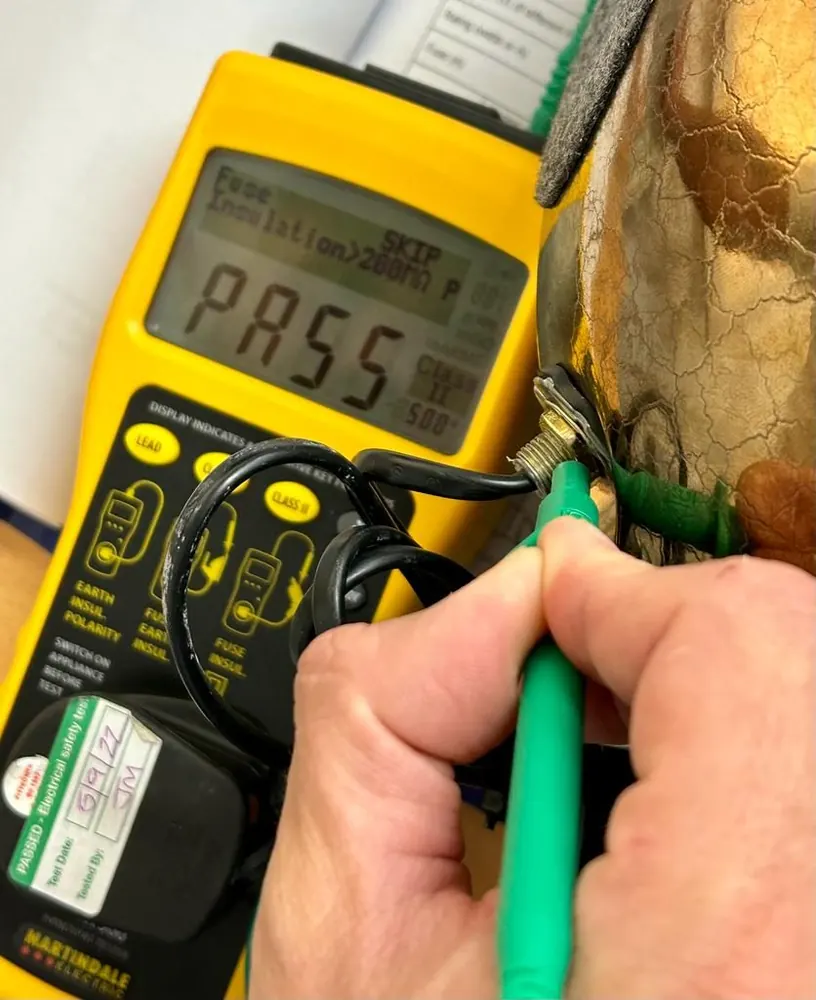
Learner using a PAT tester in class
Hands-on PAT testing practice
Group of learners on a PAT testing course
Learners testing electrical equipment
Learner carrying out a PAT test
Learners inspecting an appliance together
100% Money-Back Guarantee
If you don't pass your PAT testing course, we'll refund your booking in full.

Course highlights

  • Digital certificate provided
  • Industry recognised qualification
  • One-day course · 9:00–16:00
  • Over 1,822 5-star Trustpilot reviews
  • Content follows the IET COP 5th Edition
  • Trained by qualified industry experts
  • Clear, easy-to-follow content — no prior experience needed
  • Bulk discounts for group enrolments

What You'll Learn

A complete, practical grounding in PAT testing

This PAT Testing Course gives learners a thorough and practical grounding in:

  • Electrical safety and common electrical dangers
  • The role of portable appliance testing (PAT) in workplace safety
  • Visual inspections and identifying faults in electrical equipment
  • Equipment construction and earthing classification
  • How to conduct in-service inspection and testing
  • Using a PAT testing machine to run tests correctly
  • Earth continuity, insulation resistance, earth leakage and load tests
  • Understanding and recording test results
  • Responsibilities under electrical safety regulations
  • How to ensure electrical equipment remains safe for continued use

You'll spend real time working with an actual PAT tester in our hands-on learning zone, so you leave the day genuinely confident and competent to test independently.

Training You Can Trust

Delivered by electrical safety professionals

This PAT testing course is delivered by experienced electrical safety professionals and is fully aligned with the IET Code of Practice for the in-service inspection and testing of electrical equipment.

Although PAT testing is not a statutory obligation in itself, it is universally recognised as a cornerstone of electrical safety management. This course equips learners with the knowledge, hands-on skills and legislative understanding needed to fulfil their duty of care with confidence.

Everyone who successfully completes the course receives a training and competence certificate, providing clear evidence that they are qualified to carry out PAT testing to the expected standard.

Experienced PAT testing instructor at Skills Training Group

Why Take This Course?

Protect people and prove compliance

Faulty or poorly maintained electrical equipment is a real cause of workplace fires and injuries, and in a city with Sheffield's industrial, manufacturing and engineering base that's a risk worth managing properly. Completing this course lets you:

  • Reduce workplace accidents caused by faulty appliances
  • Understand your legal responsibilities under UK health & safety law
  • Ensure compliance with HSE and insurance requirements
  • Improve awareness of safe electrical working practices
  • Protect yourself and colleagues through better risk control
  • Demonstrate competence and due diligence during audits

Completing this course helps you build a proactive safety culture within your organisation and demonstrates tangible compliance with the UK's electrical safety regulations.

Course Content

Seven focused, hands-on modules

Training is structured into focused, interactive modules that build your knowledge step by step:

01 Introduction to PAT Testing and Electrical Equipment

The first module lays the groundwork for everything you'll do throughout the day. You'll discover precisely what Portable Appliance Testing involves, why it exists and how it sits within an organisation's broader electrical safety arrangements. Key industry terminology is introduced clearly so that every subsequent module feels accessible from the outset.

You'll also get to grips with the categories of electrical equipment you'll regularly encounter — portable, movable, hand-held, stationary, fixed and IT equipment — as well as the three equipment classes (Class I, Class II and Class III) that govern how an appliance is protected from electric shock. Grasping these distinctions early is vital, because an appliance's class directly determines which tests must be applied.

02 Electrical Safety, Electrical Dangers and Relevant Legislation

Before you handle any testing instrument, you need a clear picture of the hazards you're managing. This module explains the mechanisms by which electricity causes injury and death — electric shock, burns and fire — and the conditions that make defective equipment a genuine danger in the workplace.

The module then maps out the legislative framework underpinning PAT testing across the UK. You'll study the Health and Safety at Work etc. Act 1974, the Electricity at Work Regulations 1989, the Provision and Use of Work Equipment Regulations 1998 (PUWER) and connected duties of care. A point that's commonly misunderstood is also addressed head-on: no single law mandates PAT testing by name, yet duty-holders are legally obliged to maintain electrical equipment in a safe condition — and inspection and testing is the accepted way of discharging that obligation. You'll finish the module clear on who bears that duty and what "reasonably practicable" means in day-to-day practice.

03 Visual Inspections and Equipment Construction

The formal visual inspection is the single most powerful tool in the PAT process, accounting for the vast majority of faults found before a meter is ever connected. This module trains you to conduct a thorough visual inspection and to recognise the tell-tale signs of damage, deterioration and misuse that justify withdrawing an appliance from use.

We also look inside the equipment: correct plug wiring in accordance with BS 1363, appropriate fuse selection, cable and flex condition, strain-relief integrity, and the overall soundness of the casing and connections. You'll understand how an appliance's construction links to its equipment class, and you'll be able to distinguish the routine user checks that all staff should perform from the formal visual inspection carried out by a competent person.

04 Practical Instruction Using PAT Testing Equipment

This is the point at which the training becomes genuinely practical. In the dedicated learning zone you'll work with real PAT testing instruments, learning to set them up and operate them safely and confidently. The module introduces the range of testers you may encounter in practice — from straightforward pass/fail units to sophisticated downloadable instruments capable of storing and exporting results.

Through repeated practice you'll develop correct connection technique, appreciate the importance of using calibrated equipment, and build the kind of hands-on confidence that only comes from actually doing it. By the time the module ends, picking up a PAT tester will feel entirely natural.

05 Inspection and Testing Procedures

This module teaches you the formal test sequence and how to apply it correctly to different types of appliance. You'll work through each of the core electrical tests in turn — earth continuity testing, insulation resistance testing, lead and polarity checks, and functional checks — and you'll understand both the purpose of each test and what it reveals about the condition of the appliance under test.

A particular focus is placed on how the correct test sequence varies between Class I and Class II equipment, ensuring you always apply the right tests in the right order. Safe working practice runs as a thread throughout, so every test you conduct is both meaningful and carried out without putting yourself or others at risk.

06 Interpreting Test Results and Record Keeping

Producing test results is only half the job — you also need to interpret them correctly. This module teaches you to read your results against accepted limits, make a confident pass/fail judgement and take the appropriate action when an appliance fails. You'll learn how to label tested equipment clearly and how to maintain records that stand up to scrutiny.

We also address how to set sensible and defensible retest intervals. Drawing on the risk-based methodology of the current IET Code of Practice — which has moved away from fixed-frequency timetables — you'll learn to determine inspection and testing frequencies by reference to the type of equipment, its working environment, frequency of use and the people who use it. Robust record-keeping and a well-maintained asset register are presented as the foundation of ongoing compliance and due diligence.

07 Legal Requirements, Non-Statutory Requirements and the IET Code

The final module brings everything together and anchors your new competence within its proper regulatory setting. You'll understand the distinction between statutory requirements — the law you are bound to follow — and non-statutory guidance that represents recognised best practice, and why both carry weight for anyone performing PAT testing professionally.

Central to this module is the IET Code of Practice for In-Service Inspection and Testing of Electrical Equipment, now in its 5th edition. We walk through what the Code says, how it supports and gives practical shape to the relevant legislation, and how to use it as your primary reference document. You'll finish the course with a firm grasp of what competence means in this field, how to demonstrate due diligence, and how to carry out PAT testing to a standard that is both professional and legally defensible.

Learners devote a substantial portion of the day to practical, hands-on work in the learning zone using real testing instruments and a range of appliance types.

Assessment

Prove your competence with confidence

Competence is confirmed through a practical assessment and a structured knowledge check carried out during the course.

Learners must show that they can conduct PAT testing safely, correctly interpret their test results, and apply the IET Code of Practice in a realistic scenario.

100% money-back guarantee — we're confident you'll pass.

Your Skills Training Group competence certificate

On successful completion you'll be awarded a training and competence certificate issued by Skills Training Group, confirming your ability to carry out portable appliance testing safely and to the required standard.

The certificate shows that you have met the competence standard the HSE expects of anyone performing PAT testing under the Electricity at Work Regulations 1989 and that you are equipped to apply the IET Code of Practice (5th edition) — the benchmark recognised across the industry — in day-to-day practice.

It confirms you can:

  • Safely conduct visual inspections and instrument testing on Class I and Class II appliances
  • Correctly interpret test results and make sound pass/fail decisions
  • Apply the IET Code of Practice and record results to a professional standard

This is the evidence of competence that employers, commercial clients, landlords and facilities managers want to see before commissioning PAT testing work — and that insurers routinely require before granting public liability cover.

Certificate of Achievement
This is to certify that
Joe Bloggs
has successfully completed the
PAT Testing Course
Assessed to the IET Code of Practice for In-Service
Inspection & Testing of Electrical Equipment (5th Edition)
Derek Bruce
Operations Director
26 June 2026
Date of Issue

Suitable For

Who this course is for

This PAT Testing Course Sheffield works for a wide mix of roles and sectors found across South Yorkshire, including:

  • Facilities and maintenance staff
  • Landlords and property managers
  • Office managers and duty holders
  • Tradespeople and contractors
  • Those starting a PAT testing business
  • Qualified electricians seeking refresher training
  • Anyone responsible for electrical equipment safety

No previous electrical experience is required.

In-house private training & group bookings

Training multiple staff? We can offer a group discount on one of our public courses, or hold a private training course at your workplace for a fixed rate.

Enquire about group training

Find Us

PAT Testing Training in Sheffield

Your PAT testing course is held at The Hope Centre on Bernard Road — a practical, well-equipped training space in south Sheffield, easily reached by road, bus or rail from across South Yorkshire.

The Hope Centre
Bernard Road, Sheffield
South Yorkshire, S2 5BQ
Free on-site parking available

Getting here

By bus: Several First South Yorkshire services stop on Bramall Lane and Queens Road, a short walk from Bernard Road; routes 25, 26 and 83 all pass within a few minutes of the venue. From Sheffield city centre the journey takes around 10 minutes, with a 5-minute walk from the nearest stop.

By train: Sheffield railway station is approximately 1 mile from The Hope Centre — around a 20-minute walk or a quick 5-minute taxi ride. East Midlands Railway, CrossCountry and TransPennine Express connect Sheffield to Leeds, Manchester, London, Derby and Doncaster, making the venue easy to reach from across the region.

By car: From the M1 leave at Junction 33 and follow the A57 Sheffield Parkway towards the city centre, then take the A61 (Queens Road) southbound; Bernard Road is a short turn off Queens Road in the Park Hill/Highfield area. The Hope Centre offers free on-site parking, so there is no need to hunt for a space on arrival.

FAQ

Frequently asked questions

Do I need previous electrical experience?
Not at all. The course is structured for complete beginners and assumes no prior electrical knowledge. Qualified electricians are equally welcome and consistently find value in the hands-on practical sessions.
Is PAT testing a legal requirement?
PAT testing is not a legal requirement in itself, but UK health and safety legislation obliges employers and duty holders to keep electrical equipment in a safe working condition. PAT testing is the most widely accepted way of demonstrating that duty of care has been met.
Will I use a real PAT testing machine?
Yes — hands-on practice with real PAT testing machines is central to the day. You'll spend significant time in the learning zone building genuine practical competence with the equipment.
Do I need to bring my own PAT tester?
No. All PAT testing equipment needed for the course is provided on the day — you just need to turn up ready to learn.
Can I use my own PAT tester?
Yes, you're welcome to bring the tester you use in your day-to-day work. If you plan to do so, please let us know in advance so we can make sure everything is ready for you.
Is this suitable for starting a PAT testing business?
Absolutely. The course covers all the skills, knowledge and legislation you need to test competently and independently, making it an excellent starting point for anyone planning to launch a PAT testing business.
Do I receive a competence certificate?
Yes. Every learner who passes the course receives a training and competence certificate confirming they are a competent PAT tester.
Who is the course certificated by?
The course is aligned with the IET Code of Practice (5th Edition) and the certificate is issued by Skills Training Group — an established and recognised provider of electrical safety training.
Does the PAT Testing Course expire?
There is no fixed expiry date on the certificate, but refresher training every three years is recommended to keep pace with any updates to the IET Code of Practice and to maintain best practice.
Is there parking at The Hope Centre on Bernard Road?
Yes — The Hope Centre provides free on-site parking for course delegates. Bernard Road is located in the Park Hill and Highfield area of south Sheffield, just off Queens Road (A61), so it is easy to reach from the M1 at Junction 33 via the Sheffield Parkway. There is no need to budget for a car park on the day.
Which areas around Sheffield does this PAT testing course cover?
The course is open to anyone across Sheffield and the wider South Yorkshire region. We regularly see delegates from Rotherham, Barnsley, Doncaster, Chesterfield and Worksop, as well as from areas within the city such as Hillsborough, Ecclesall, Attercliffe, Stocksbridge and Beighton. If you can reach Bernard Road, S2 5BQ — whether by car, bus or via Sheffield railway station — you are welcome to book a place.

Why train with us?

  • Trusted by thousands of UK learners
  • Training that complies with industry requirements
  • Outstanding customer support
  • Experienced industry-expert trainers

We're highly rated

Skills Training GroupCareer & Education Provider
5.0
Based on 1,822 reviews
PAT Testing Course Sheffield £195 + VAT · 1-day course
Book Now